
Your Birth Plan Isn’t a Script
It’s a nervous system tool for confidence, communication, and flexibility. Digital product is included in this post.


💌This post is part of my ongoing series Anatomy of a Birth Plan—where we explore preference options, decision making techniques, and communication strategies that supports your birth into motherhood, not matter how it unfolds.
If you want more like this, subscribe—it’s completely free 🤍
Hey you,
I am so excited to announce a new series: The Anatomy of a Birth Plan.
In my work as a doula, I spent hours with women working through their preferences for birth and the postpartum period — and honestly, this was one of my favorite parts of the job. Not because birth plans are fun paperwork, but because of what the process does for a family. Done well, birth planning is one of the most powerful tools we have for feeling emotionally prepared and confident walking into one of the biggest transitions of your life. But is often misunderstood and underused as a result.
I approached birth planning a little differently than most doulas, because early on I understood a pattern that changed the way I held these conversations:
The process matters more than the outcome.
When you focus on the outcome you’ll loose sight of the educational process that actually prepares your mind for birth.
The final document isn’t the point. The decision-making that goes into it is.
Birth planning is an educational process. It prepares you to make informed decisions based on situational awareness, evidence, and your own deeply personal preferences — so that no matter how your birth unfolds, you walk in knowing yourself, knowing your options, and knowing how to communicate both.
In this series we’ll dive into the various birth and postpartum preferences, decision making techniques, and communication strategies that will support you in feeling safe, prepared, and confident as you step into motherhood. I’ll break down the evidence behind the interventions everyone wonders about and the real life experiences that informed the very topics I discuss.
I cant wait to get into it!
Lets start with the basics:
What Is a Birth Plan?
A birth plan is a written document that outlines your preferences for labor, birth, and the immediate postpartum period. It tells your care team how you want to be supported, what interventions you're open to, and what matters most to you when things get real.
But here’s what nobody tells you: a birth plan isn’t about controlling your birth. It’s about knowing yourself well enough to communicate clearly — even when you’re in the middle of intensity it will guide decision making and ground you in situations maybe you weren’t prepared for.
The best birth plans don’t read like a legal document. They open a conversation. A good one gives your care team something they can glance at, understand immediately, and use as a starting point for talking with you — not a wall of text that can be easily misunderstood. [1]
Think of it less like a script and more like an introduction. One that says I’ve thought about this, I know what I need, and I trust you to work with me.
Flexibility isn’t a flaw in your birth plan. It’s a feature. Going into birth with a clear sense of your preferences and an openness to pivots means you’re prepared for the full picture — not just the version you imagined.
The goal of this process isn’t a perfect plan. It’s a prepared you and supportive team.
Why It Matters More Than You Think
Most people think of a birth plan as a practical document. A checklist. Something to hand to a nurse and hope for the best.
But the real value of a birth plan has almost nothing to do with the piece of paper.
✓ It prepares your nervous system. The process of making one — sitting down and actually thinking through what you want, what you’re afraid of, what matters most to you and why — gives you a felt sense of readiness that no packing list or hospital tour can give you. [2]
✓ It turns the unknown into something you’ve already thought through. When you’ve sat with the options, done the research, and landed on what feels right for you — you walk into that birth room with a different kind of confidence. Not the “nothing will go wrong” kind. The “I know myself and I know my options” kind. [3]
✓ It prepares you for every scenario — not just the one you planned for. I have a lot of mamas come to me planning for a completely unmedicated birth. We still walk through the epidural conversation — what those scenarios look like, when it becomes a real option. We discuss all the possibilities, land on what resonates, and tuck the rest into our back pocket just in case.
Because birth doesn’t always go the way we imagined. But when you’ve already had the conversation, already sat with the options, already made peace with the range of possibilities — you’re not making decisions from fear in the middle of a contraction. You’re drawing on work you’ve already done.
A birth plan is a map of your mind — made when you had the space and clarity to think.
Important Things to Include in Your Birth Plan
A thorough birth plan covers more than just the moment of delivery. It spans the full arc of your birth experience — from the time you arrive in active labor to the first hours after your baby is born. Here’s what to make sure yours includes:
Your basic information and important context This is the stuff your care team needs to know before anything else — who your support people are, who your provider is, any allergies, and any relevant medical details like GBS status, gestational diabetes, or whether you’re planning a VBAC. Getting this on paper upfront means nobody has to dig through a chart to find it when it matters.
Your active labor preferences This is the heart of your plan. How do you want to manage pain? Do you want an IV or a saline lock? Continuous monitoring or intermittent? Do you want freedom to move around, eat and drink, wear your own clothes? These are the preferences that shape what labor actually feels like for you — and they’re worth thinking through carefully.
Your pushing and birth preferences This section often gets overlooked in the planning process, but it’s where some of the most important decisions live. knowledge of episiotomies and assisted deliveries, pushing positions, whether you want coaching or quiet during delivery, whether you want a mirror, whether your partner wants to help catch — these details matter, and having them written down means you don’t have to find words for them in the middle of pushing.
Immediate postpartum and newborn care This is the section most birth plans skip entirely — and it’s one of the most important. What happens in the minutes and hours after your baby arrives matters just as much as what happens before. Delayed cord clamping, skin to skin, the golden hour, newborn procedures, vitamin K, eye ointment, feeding preferences — these decisions deserve the same thought and intention as everything else on your plan.
Research shows that what happens immediately after birth significantly shapes how a mother perceives her overall birth experience. Women who have immediate skin-to-skin contact with their newborn report lower levels of fear and guilt during birth and are at a meaningfully lower risk of post-traumatic stress symptoms — including after cesarean births [4].
That first hour of uninterrupted bonding isn’t just a nice moment. It’s a nervous system event for both of you.
This is exactly why your postpartum preferences belong on your birth plan — not as an afterthought, but as an intentional part of how you want to enter motherhood.
What Most Birth Plans Miss
Most birth plans cover the middle. They miss the edges — the decisions that happen before your first contraction and in the first hours after your baby arrives.
✓ Length and readability. A birth plan that’s too long works against you. If your care team can’t scan it in under a minute, there’s a good chance they won’t. Shorter, clearer, and visual wins every time. [1]
✓ A space for your own words. Icons and checkboxes can tell someone what you want. They can’t tell them who you are. Leave room for your own voice — a few sentences about what matters most to you, what you need them to know, what you want them to understand walking in. That’s what turns a form into a real conversation.
✓ Preferences for every stage. If your plan only covers active labor, you’re leaving a lot of important decisions to chance. Make sure yours goes all the way through.
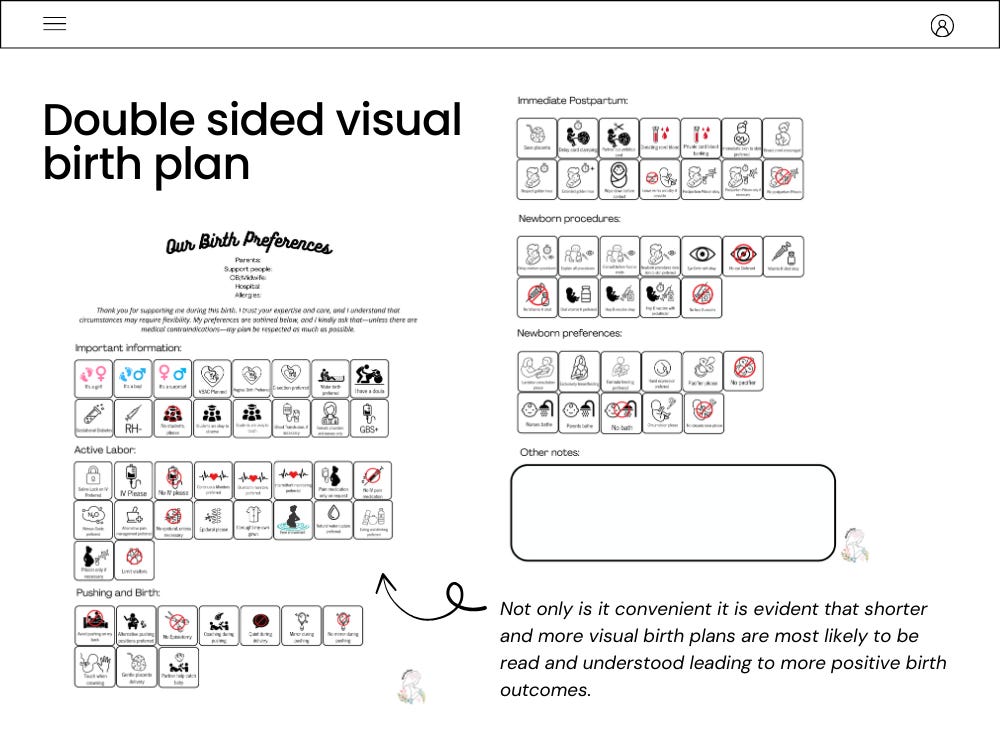
Mind the Bump has a Visual Birth Plan for sale that hits all the marks. Check it out Below:
Birth Plan Misconceptions
Birth plans have a reputation problem. Here are the most common things people get wrong — and the truth behind them.
“A birth plan means you’re trying to control your birth.” A birth plan is not a contract. It’s a communication tool. It tells your care team who you are and what you need — it doesn’t tie anyone’s hands. The best birth plans are written in the spirit of collaboration, not control, and a good care team will receive it that way. [1]
“Birth is unpredictable, so a birth plan is pointless.” Birth being unpredictable is exactly why a birth plan matters. When things shift — and they often do — you want your care team to already know your values, your priorities, and your preferences across a range of scenarios. Discussing different scenarios during the planning process can actually help you prepare for unforeseen circumstances. [3] A birth plan doesn’t assume everything will go perfectly. It prepares you for the fact that it might not.
“It’s just a checklist.” A checklist is a list of tasks to complete. A birth plan is a reflection of your values, your research, and your deeply personal preferences. The process of making one is an education in itself — one that prepares you to make informed decisions in real time, not just check boxes ahead of time. [2]
“Providers don’t read them.” Some don’t. And that’s worth knowing. Which is exactly why the format of your birth plan matters as much as the content. A visual, scannable, one-page plan is far more likely to be read, referenced, and respected than a dense multi-page document. Make it easy to engage with and most care teams will. [1]
How to Actually Use Your Birth Plan (advocacy, timing, provider convos)
Making a birth plan is only half of it. Here’s how to make sure it actually does its job.
📅 Make it during pregnancy — not the week before your due date. You want time to sit with it, research your options, and have real conversations before labor starts. Start preparing in the time you need to feel confident and ready for motherhood. Just keep in mind that some preference might not be confirmed until closer to your due date
🩺 Go through it with your provider before you’re in labor. What’s available to you depends on where you’re giving birth. Standards and policies vary a lot between hospitals, birth centers, and home birth settings. Walking through it ahead of time means no surprises — for either of you. [3]
Doula Tip: Have your provider sign your birth plan. This adds a stamp of approval that will translate across your care team, no matter who you provider will be at birth (Your primary doctor might no be on call the day you go into labor)
⚠️ Know the difference between standard practice, requirement, urgent and emergent. This one is important. Standard practice is what’s routinely done — it is not the same as what’s medically necessary. Your provider might prefer you deliver on your back. That doesn’t mean you have to. You are allowed to ask: is this necessary, or is this just how it’s usually done?
Understanding urgency is also worth noting. decision making during an urgent situation is critical in avoiding emergency situations where there is no time to think, process or be in your body. Understanding what this looks like and how to ground yourself enough through intensity to make informed decisions is critical and can be included in the birth plan making process. A doula can be a huge support here — helping you know the difference and feel confident advocating for yourself in the moment.
📋 Bring multiple copies. At least three to four. One for your chart, and one for each nurse you meet — because shift changes happen and your care team will not always pass your preferences along. Every new nurse who walks into your room may be hearing them for the first time. Don’t assume. Hand it over and discuss it every time.
🤝 Introduce it — don’t just hand it over. A simple “I have a few preferences I’d love to share with you” changes the whole dynamic. It’s an offering, not a demand. Most care teams respond really well to that.
💛 Designate an advocate. When you’re deep in labor, you may not be able to speak for yourself. Your support person needs to know your plan as well as you do — because they are your voice when you need to go inward.
What Makes a Birth Plan Template Worth Using
If you've made it this far, you already know a birth plan is worth making. The question is how to actually build one without staring at a blank page wondering where to start.
You could absolutely start from scratch — and some people do. But a good template does something a blank page can’t: it asks you questions you didn’t know to ask. It surfaces the decisions that are easy to miss until you’re already in the room wishing you’d thought about them.
Here’s what to look for:
✓ It covers the full arc — not just labor. Active labor, pushing and birth, immediate postpartum, and newborn care. If it stops at delivery, it’s missing half the picture.
✓ It’s visual and easy to read at a glance. Visual plans communicate faster, create less room for misinterpretation, and are far more likely to actually be referenced in the room. [1]
✓ It’s written in preference language. Preferred. Only if necessary. Please. It is important to me. That framing sets a collaborative tone before your care team has even introduced themselves.
✓ It leaves room for your voice. Icons communicate a preference. They can’t communicate who you are. Look for a template that gives you space to say what matters most in your own words.
✓ It’s one page, double sides. Clear. Scannable. Easy to hand to every nurse who walks through that door.
💝You Don’t Have To Look Far To Find One
The Mind the Bump Visual Birth Plan was designed with every one of these things in mind — because you deserve something that actually works in the room. Every section, every icon, every blank space was built with you in mind — the mama who wants to feel informed, prepared, and genuinely ready for whatever birth brings.
It’s a paid resource, and it comes with a little something extra: download the Visual Birth Plan and receive 10% off an add-on session with me to walk through it together. We’ll go through your preferences, talk through your questions, and make sure you feel solid in every decision on that page.
Because you don’t have to figure this out alone —Mind the Bump is here to support you.
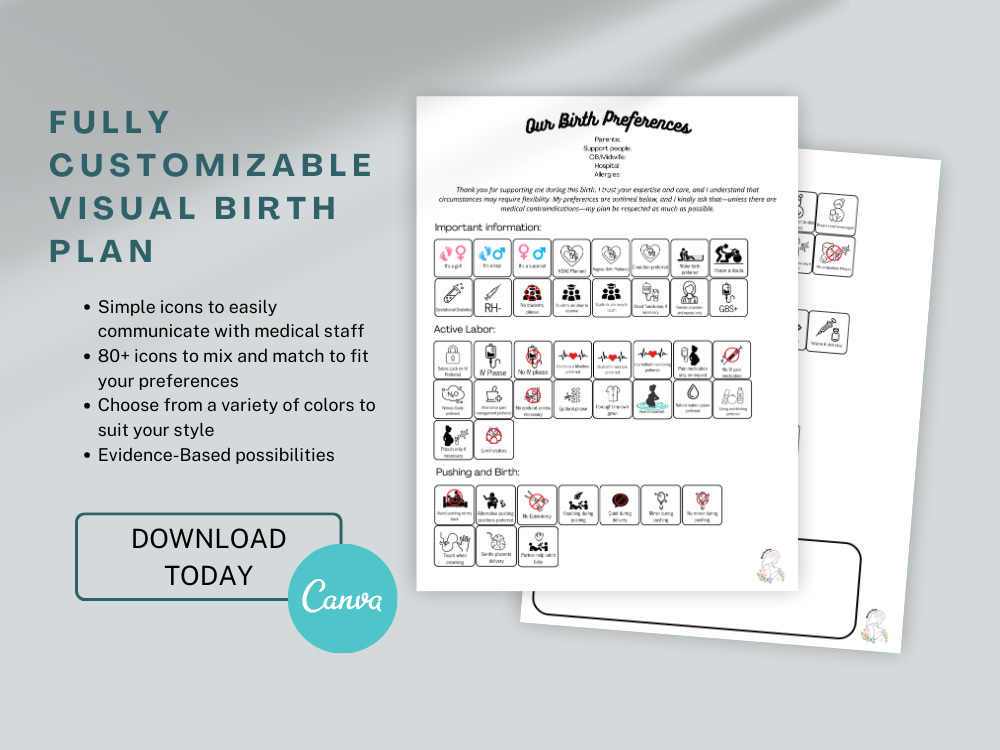
Grab yours below or share with a friend who needs it →
Up Next
04/7: Foundations of Safety: Sleep & Circadian Rhythm (Status: ongoing)
04/14: Anatomy of a Birth Plan: Topic TBD By YOU
Comment below what birth preference you would be most curious about?
References
Shareef, N., et al. (2024). The contribution of birth plans to shared decision-making from the perspectives of women, their partners and their healthcare providers. PLOS ONE. https://journals.plos.org/plosone/article?id=10.1371/journal.pone.0305226
Shareef, N., et al. (2022). The role of birth plans for shared decision-making around birth choices of pregnant women in maternity care: A scoping review. Women and Birth, 36(4), 327–333. https://www.sciencedirect.com/science/article/pii/S1871519222003547
Birth Plans: A systematic, integrative review into their purpose, process, and impact. (2022). ScienceDirect. https://www.sciencedirect.com/science/article/abs/pii/S0266613822001401
Kahalon, R., et al. (2022). Mother-infant contact after birth can reduce postpartum post-traumatic stress symptoms through a reduction in birth-related fear and guilt. Journal of Psychosomatic Research, 154, 110716. https://www.sciencedirect.com/science/article/abs/pii/S0022399922000010
Hi, Abigail! Thanks for talking with me and saying it was okay to write my thoughts about birth plans. My background is as a doula, monitrice, student midwife, home birth midwife, and birth center midwife. I've assisted or caught right at 900 babies since 1982. I retired from midwifery in 2011, but have kept my hunger for birth info and knowledge all these years since.
So when I saw the title to this post, I smiled hugely, because it has been something those in my former birth world have said hundreds (thousands!) of times. I smile because, apparently, it still needs to be said! I thought I would share a couple of ways I found to curtail expectations and also to make friends with the providers in and out of the hospital. (Even if you don't see them as allies, it's not a bad idea to pretend you do.)
I stopped calling them "Birth Plans," but shifted to "My Birth Wish List." Birth cannot be planned unless it is a cesarean and even then the baby runs the show... not the doctor, not the nurses, and not the parents. The way I describe it is the mother and baby are doing a dance with each other. While the mother might know the dance steps, the baby is the one who leads. If the baby twirls mom around on the dance floor, she has to follow the baby. If the baby tromps on her feet, mom has to make allowances for that. When the dance is during labor and birth, one of the dancers (the baby) cannot be counted on to do all the dance steps correctly. Where the baby goes, the mother (and hence, the birth team) follows.
Mom can make all the plans she wants, but her wishes are secondary to the baby's. Therefore, writing a "Wish List" allows for all the whirling and twirling that can happen in the Ballroom of Birth.
I also taught families to use a 4x6" index card... better yet, a 3x5 card... front side only. Pick the absolutely most wanted wishes for the birth. "Do not allow my MIL in the birth room." "Do not call out the sex of the baby." Things like that.
Writing things like, "I want to be able to walk in labor" is a wasted request because that is a normal experience in the hospital. (And if it's not, hire a doula and stay home longer!) Ditch the typical hospital protocols (use a birth ball, listen to music, eat and drink in labor, want to use a mirror, have an unmedicated birth, etc.) and then ditch the things you have zero say in because, in an emergency, things will be done without discussion. A consent is signed when signing in specifically saying they can do whatever they need to do to save the mom's or baby's life. For example, episiotomies are done incredibly rarely now and putting "No episotomy" on a birth plan screams "I don't know what normal labor and delivery practices are!" If the baby is in trouble and needs to be born NOW... there is zero discussion about an episiotomy; it's going to be done. Same with a vacuum or forceps (which I have not seen used in almost forever).
More wasted items on a Birth Plan or Birth Wish List are delayed cord clamping, skin-to-skin, who cuts the cord, etc. with baby because those are also standard L&D practices.
Eye ointment or Vitamin K on a birth plan for the nurse is pointless. The Newborn Nursery staff takes care of the baby postpartum, not your labor nurse. If you haven't gotten your requests into the baby's chart already, a separate 3x5 card for the labor nurse to give to the newborn nurse *while you are still in labor!* is important.
I'd love to see a modified Birth Wish List, Abigail. Removing unnecessary verbiage helps the family *much* more than anything else to develop a great rapport with the labor and delivery team.
I look forward to your thoughts!
Barb Herrera <formerly, the Navelgazing Midwife>